Nuclear fusion has never been closer to reality. Private companies have raised billions, national programs are building reactor-scale experiments, and in December 2022, the National Ignition Facility demonstrated net energy gain from fusion for the first time. Headlines declare that commercial fusion power is just around the corner.
The headlines are wrong — or at least incomplete. Between where we stand today and a fusion power plant that feeds electricity into the grid, there are at least ten major unsolved problems. Some are physics challenges we have been wrestling with for decades. Others are engineering problems that only become visible at reactor scale. All of them must be solved, most of them simultaneously, before fusion energy becomes a reality.
Here is an honest accounting of what remains.
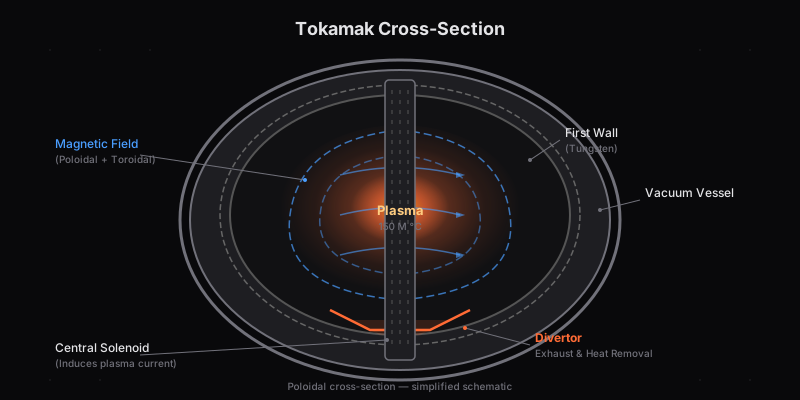
1. Plasma Disruption Control
A plasma disruption is the nightmare scenario for any tokamak operator. In milliseconds, a stable, 150-million-degree plasma can lose confinement and dump its full energy — hundreds of megajoules — onto the reactor walls. The resulting forces are equivalent to a small explosion. On ITER, a single unmitigated disruption could damage the machine badly enough to require months of repair.
Current mitigation strategies rely on massive gas injection to radiate the plasma energy away before it hits the walls. Machine learning models trained on data from JET and DIII-D can now predict disruptions with roughly 95% accuracy and under 30 milliseconds of latency. But 95% is not enough when the consequence of a miss is catastrophic. A commercial reactor running continuously would need disruption rates near zero, not one-in-twenty. Closing that gap is one of the hardest control problems in all of engineering.
Learn more about this roadblock
2. First Wall Materials
The first wall is the inner surface of a fusion reactor — the material that directly faces the plasma. It must withstand 14 MeV neutron bombardment, extreme heat fluxes, and hydrogen isotope implantation, all while maintaining structural integrity for years rather than weeks.
Tungsten is the leading candidate because of its high melting point and low sputtering rate. But neutron irradiation makes tungsten brittle. At reactor-relevant fluences (beyond about 5 displacements per atom), pure tungsten loses most of its ductility and becomes prone to cracking. Recent work on self-healing tungsten-rhenium alloys with engineered nano-voids shows promise — retaining 87% of room-temperature ductility after 10 dpa irradiation — but these materials have only been tested in fission reactors. No fusion-relevant 14 MeV neutron source exists at the flux levels needed for proper qualification. We are designing first walls for conditions we cannot yet reproduce in a laboratory.
Learn more about this roadblock
3. Tritium Breeding
Deuterium-tritium fusion requires tritium fuel, but tritium does not occur naturally in useful quantities. Its half-life is only 12.3 years. The entire world's supply, produced as a byproduct of heavy-water fission reactors, is approximately 25 kilograms and shrinking. A fusion power plant would burn through roughly 55 kilograms of tritium per gigawatt-year of output.
The solution is to breed tritium within the reactor itself, using lithium blankets that capture fusion neutrons. The tritium breeding ratio (TBR) must exceed 1.0 — the reactor must produce more tritium than it consumes. On paper, blanket designs achieve TBR values of 1.05 to 1.15. In practice, no breeding blanket has ever been tested at reactor scale. Neutron leakage, parasitic absorption by structural materials, and tritium extraction inefficiencies all erode the margin. The difference between TBR = 1.05 and TBR = 0.95 is the difference between a self-sustaining power plant and one that runs out of fuel.
Learn more about this roadblock
4. Long Duration Confinement
Sustaining a high-performance plasma for minutes is impressive. Sustaining one for months is what a power plant requires. The current record for steady-state H-mode plasma is on the order of 1,000 seconds in tokamaks, but not at reactor-relevant temperatures and densities simultaneously.
Long-pulse operation introduces problems that short experiments never encounter. Current drive systems must replace the transformer action that initiates plasma current in a tokamak — and they must do so efficiently enough that the reactor's energy balance stays positive. Bootstrap current, a self-generated current arising from pressure gradients, helps but is difficult to control precisely. Material erosion, impurity accumulation, and diagnostic degradation all compound over time. Achieving steady-state operation is not just about sustaining the plasma — it is about sustaining every subsystem around the plasma for durations that have never been attempted.
Learn more about this roadblock
5. HTS Superconducting Magnets
High-temperature superconducting (HTS) magnets, particularly those made from REBCO (Rare Earth Barium Copper Oxide) tape, have transformed the fusion landscape. They can produce magnetic fields above 20 Tesla — roughly twice what conventional niobium-tin superconductors achieve — enabling the compact, high-field tokamak designs pursued by companies like Commonwealth Fusion Systems with their SPARC experiment.
The challenge is scaling from laboratory demonstrations to reactor-sized coils that must operate reliably for decades. REBCO tape is mechanically delicate; the superconducting layer is a thin ceramic film deposited on a metallic substrate. Under the enormous Lorentz forces in a high-field magnet, delamination and degradation become serious concerns. Recent tests show that enhanced tape architectures can survive 10,000 stress cycles at 25 Tesla with less than 2% performance degradation. But reactor magnets will see millions of cycles, and the manufacturing yield of high-performance REBCO tape must increase substantially to bring costs down to commercially viable levels.
Learn more about this roadblock
6. Divertor Thermal Management
The divertor is the exhaust system of a tokamak, where the plasma's waste heat and helium ash are removed. In a reactor, the divertor must handle steady-state heat fluxes exceeding 10 MW/m-squared — comparable to the heat flux on a spacecraft re-entering the atmosphere, but sustained indefinitely rather than for minutes.
No solid material can survive these conditions long-term through simple passive cooling. Active cooling with high-pressure water or helium helps, but creates its own engineering challenges at reactor scale. Liquid metal concepts, particularly flowing lithium, have shown exciting early results — a liquid lithium divertor module on NSTX-U successfully handled 12 MW/m-squared with no surface damage over 200 plasma discharges. But flowing liquid metal inside a strong magnetic field introduces magnetohydrodynamic drag and stability questions that remain unresolved. The divertor is arguably the component most likely to limit the lifetime and availability of a fusion power plant.
Learn more about this roadblock
7. ELM Control
Edge-Localized Modes (ELMs) are periodic instabilities at the plasma edge that release bursts of energy onto plasma-facing components. A single large ELM in ITER could deposit enough energy to melt a layer of the tungsten divertor surface. Extrapolated to a power plant, uncontrolled ELMs would erode plasma-facing components in weeks.
Two main approaches show promise. Resonant magnetic perturbations (RMPs) — small magnetic fields applied from external coils — can suppress or mitigate ELMs, but they also degrade plasma confinement. Pellet injection can trigger small, frequent ELMs to prevent the buildup of large ones, but the required pellet fueling rates and injection geometries are complex. The ideal solution might be operating in an ELM-free plasma regime altogether, such as the QH-mode or I-mode, but these regimes have not yet been demonstrated at reactor-relevant parameters. Solving the ELM problem likely requires a combination of approaches tailored to specific operating scenarios.
Learn more about this roadblock
8. Q > 1 Engineering
When fusion scientists talk about Q — the ratio of fusion power output to heating power input — they usually mean the physics Q of the plasma alone. NIF's 2022 result achieved Q > 1 by this narrow definition. But a power plant needs engineering Q greater than 1: the total electrical output must exceed the total electrical input, including magnets, cryogenics, heating systems, tritium processing, cooling, and everything else.
This is a systems engineering challenge of enormous complexity. Each subsystem must work not just individually but in concert, with efficiency losses compounding at every stage. Plasma heating systems are typically 30-50% efficient at converting electrical power to plasma heating. Thermal-to-electrical conversion adds another efficiency factor. When you multiply everything through, a plasma physics Q of 10 might yield an engineering Q of only 2-3. Reaching the Q-physics values needed for a viable power plant demands solving most of the other nine roadblocks on this list simultaneously, making this the ultimate integration challenge for fusion energy.
Learn more about this roadblock
9. Plasma-Wall Compatibility
The boundary between a 150-million-degree plasma and a solid wall is the most extreme material interface in any engineered system. Ions striking the wall sputter surface atoms into the plasma, where they radiate energy and cool the plasma edge. Redeposition creates mixed-material layers with unpredictable properties. Hydrogen isotopes become trapped in the wall, raising tritium inventory and safety concerns.
Managing these interactions requires understanding physics at scales ranging from atomic sputtering events to meter-scale plasma transport. The plasma edge conditions determine wall erosion rates; the wall erosion determines plasma edge conditions. This coupling makes the problem fundamentally nonlinear and difficult to model. Experimental access to the relevant conditions is limited because current machines operate at lower power densities and for shorter durations than a reactor. Plasma-wall compatibility is the kind of problem that may only reveal its full severity when the first reactors begin operating — which is precisely why it needs more attention now.
Learn more about this roadblock
10. Predictive Turbulence Modeling
Plasma turbulence determines how quickly energy and particles leak out of the magnetic confinement. Getting the transport predictions right is essential for designing reactors: underestimate turbulent transport and you build a machine that cannot reach ignition; overestimate it and you build one that is unnecessarily large and expensive.
The gold standard for turbulence modeling is gyrokinetic simulation, which resolves the relevant physics from first principles. The problem is computational cost: a single gyrokinetic simulation of a reactor-scale plasma can consume millions of CPU-hours. Reduced models based on quasilinear theory can run 10,000 times faster and reproduce heat flux predictions within about 15%, but they rely on assumptions that may break down in reactor regimes that have not yet been explored experimentally. Machine learning surrogates trained on gyrokinetic databases offer another path to fast, accurate predictions, but they inherit the validation gaps of their training data. Until we can predict turbulent transport at reactor scale with confidence, every reactor design carries a significant uncertainty margin.
Learn more about this roadblock
The Path Forward
None of these problems is impossible. For several — HTS magnets, disruption prediction, turbulence modeling — progress in the past five years has been genuinely remarkable. But the honest assessment is that commercial fusion power requires solving all ten problems well enough and at the same time, in a single integrated machine. That is what makes fusion hard. Not any single challenge, but the conjunction of all of them.
At DeepScience, we track the latest research across all ten of these roadblocks through our AI-powered pipeline, surfacing papers and cross-domain connections that move the needle. Our Research Roadmap shows the current status of each challenge, and our daily digest delivers the most important developments straight to your inbox. If you care about where fusion actually stands — not where press releases say it stands — we built this for you.