How AI Detects Scientific Breakthroughs Before They Happen
Most scientific breakthroughs are not sudden. They are slow collisions — two ideas from different fields drifting toward each other for years before someone finally connects them. mRNA vaccine technology existed for over a decade before a pandemic made it urgent. CRISPR sequences were catalogued for twenty years before anyone realized they could edit genes.
The discoveries were not hidden. They were just in the wrong journals, read by the wrong people, described in the wrong vocabulary. The signal was there. No one was listening across the right frequencies.
DeepScience is an AI system designed to listen across all frequencies simultaneously. This article explains the technical architecture behind how it works — and why the approach produces genuine, validated cross-domain insights rather than noise.
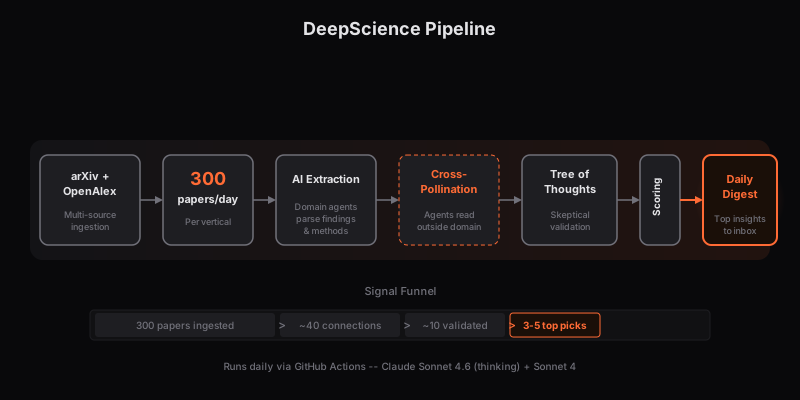
The Architecture: Specialized Agents Reading Outside Their Lane
The foundation of DeepScience's approach is a multi-agent system. Rather than building one monolithic model that tries to understand all of science, we deploy a network of specialized AI agents, each with deep contextual knowledge of a specific domain.
A materials science agent understands crystal structures, phase diagrams, and mechanical properties. A plasma physics agent understands confinement, instabilities, and energy balance. A molecular biology agent understands protein folding, gene regulation, and cellular signaling pathways.
But here is the architectural decision that makes cross-domain discovery possible: each agent is deliberately tasked with reading papers outside its own field.
The materials science agent does not just read materials science papers. It reads plasma physics, biology, and climate science papers too — looking for concepts or findings that connect back to materials science problems it already understands. Every agent in the network does the same.
This is fundamentally different from keyword search or citation-graph analysis. Those tools find connections within established networks. Our agents find connections that do not yet exist in any citation graph because no human has made them yet.
Cross-Pollination: When Independent Agents Converge
Reading broadly is necessary but not sufficient. A single agent scanning outside its domain will generate genuine insights and false positives alike. The key to filtering signal from noise is convergence across independent agents.
Suppose a new paper on arXiv describes a tungsten-rhenium alloy with exceptional neutron bombardment resistance. The materials science agent flags it. Independently, the plasma physics agent — tracking plasma-facing component degradation in tokamak fusion reactors — flags the same paper as a potential solution to first-wall erosion, a known fusion energy roadblock.
Neither agent was told to look for this. When two or more agents converge on the same cross-domain link, we treat it as a strong signal. Multi-agent convergence dramatically reduces false positives because the connection must make sense from multiple disciplinary viewpoints simultaneously.
Tree of Thoughts: The Skeptical Reviewer
Convergence alone is not enough. A material that resists neutron damage in the lab might fail at fusion reactor temperatures. Surface-level compatibility does not guarantee scientific validity.
This is where DeepScience's Tree of Thoughts (ToT) validation acts as a skeptical reviewer. Rather than evaluating a connection once, it explores multiple reasoning branches in parallel:
- Branch 1: Feasibility. Given known physical, chemical, or biological constraints, is this connection technically plausible? What are the boundary conditions?
- Branch 2: Novelty. Has this connection been explored before? Is there prior work that either supports or contradicts it? If it exists in the literature already, it is not a discovery.
- Branch 3: Roadblock relevance. Does this connection address a known bottleneck in an active research program? Connections that solve real, documented problems are more actionable than those that are merely interesting.
- Branch 4: Adversarial challenge. What is the strongest argument against this connection? What assumptions does it rely on? If those assumptions fail, does the connection collapse entirely?
Each branch generates sub-branches, creating a tree of reasoning paths. Branches that hit dead ends are pruned. Only connections that survive all four dimensions advance through the pipeline. The design is deliberately conservative — we would rather surface five high-confidence connections per day than fifty speculative ones.
The Scoring System: How Connections Are Ranked
Connections that pass Tree of Thoughts validation are assigned a composite score based on four weighted factors:
- Multi-agent consensus (30%). How many independent agents flagged this connection? Consensus is the strongest single predictor of validity.
- ToT depth (25%). How deep did reasoning go before reaching a positive conclusion? Deeper trees indicate more robust connections.
- Roadblock relevance (25%). Does the connection address a documented bottleneck in active research? We maintain a continuously updated map of known roadblocks across domains.
- Novelty (20%). We check against existing literature, patent databases, and prior DeepScience outputs. Genuinely new cross-domain links score higher than rediscoveries.
The composite score determines ranking in the daily output. Top connections appear in subscriber digests with full context: source papers, reasoning chain, domain relevance, and suggested next steps.
A Worked Example: Tungsten Alloys Meet Fusion Plasma Physics
To make this concrete, here is how the pipeline processes a real connection.
A materials science paper describes a new tungsten-rhenium-tantalum alloy that reduces helium bubble formation by 60% under ion irradiation. The materials science agent flags it as a significant advance in radiation-resistant structural materials. Independently, the plasma physics agent flags the same paper — because helium bubble formation in plasma-facing components is a critical unsolved problem for tokamak fusion reactors like ITER.
Two agents, different domains, same paper, same conclusion. Strong signal.
Tree of Thoughts validation runs four branches. Feasibility: tungsten alloys are already the baseline material for ITER, and the alloy composition is compatible with existing manufacturing. Plausible. Novelty: the specific grain boundary engineering technique is new, and the 60% reduction exceeds published benchmarks. Novel. Roadblock relevance: first-wall erosion is a top-five engineering challenge for DEMO, the post-ITER reactor. Directly relevant. Adversarial challenge: ion irradiation does not fully replicate 14 MeV fusion neutron spectra — a meaningful caveat that identifies the next experimental step rather than invalidating the connection.
Composite score: high consensus, deep validation, direct roadblock match, strong novelty. Top-tier connection, included in the daily digest.
From Detection to Daily Digest
The final stage is synthesis. Raw connections are not useful buried in technical jargon. DeepScience generates daily digests that translate each connection into accessible language while preserving scientific accuracy — including a plain-language summary, links to source papers, the reasoning chain, composite scores, and suggested next steps.
Subscribers receive digests filtered by their areas of interest. A fusion energy researcher sees the tungsten alloy connection. A climate scientist sees links between atmospheric modeling and machine learning advances.
Why This Approach Works
The power of this architecture comes from combining three properties that are difficult to achieve together:
Breadth. Multi-agent scanning covers domains no individual researcher could follow. Every paper on arXiv and OpenAlex is read by agents that understand its relevance to other fields.
Rigor. Tree of Thoughts validation ensures only scientifically grounded insights survive. Speculative or shallow connections are pruned automatically.
Speed. The pipeline runs daily. A paper published on Monday can appear as a validated cross-domain connection in Tuesday's digest. In traditional science, the same connection might take years to surface through conference serendipity.
The goal is not to replace scientific intuition but to extend it across domains and timescales beyond human capacity. The researchers still do the science. DeepScience ensures they see the connections they need to see.
Ready to receive cross-domain research intelligence? Explore our subscription plans, browse the latest daily digest, or check our research roadmap to see which domains we cover.