What is Cross-Domain Research Intelligence?
In 1928, Alexander Fleming returned from vacation to find mold contaminating his bacterial cultures. A biologist noticing a chemical phenomenon. That accident gave us penicillin — but it was not really an accident. It was a connection between two domains that no one had thought to link.
Nearly a century later, science faces a paradox. We produce more research than ever before, yet the most transformative discoveries still come from the same place: the unexpected intersection of unrelated fields. The difference today is that no human can possibly read enough to find those intersections on their own.
This is the problem cross-domain research intelligence was built to solve.
The Silo Problem in Modern Science
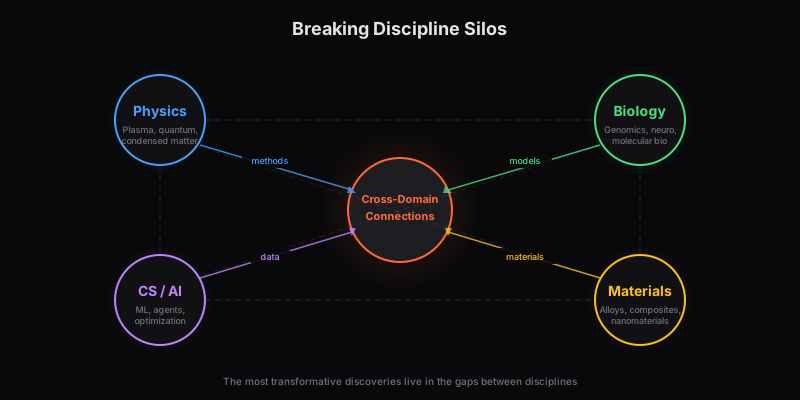
Scientific research operates in vertical silos. A materials scientist reads materials science journals. An immunologist follows immunology conferences. A physicist subscribes to physics preprint servers. Each community develops its own vocabulary, its own citation networks, its own implicit assumptions about what matters.
This specialization is necessary. Modern science is too complex for generalists. But it creates a structural blind spot: the most impactful discoveries often live in the gaps between disciplines, precisely where no specialist is looking.
Consider the numbers. Over 200,000 scientific papers are published every month across platforms like arXiv, PubMed, and OpenAlex. A dedicated researcher might read 20-30 papers per week in their own field. That means even the most voracious reader covers roughly 0.05% of monthly output — and almost none of it outside their domain.
The result is a knowledge fragmentation problem that grows worse every year. Important connections go unnoticed for years or even decades, not because the information does not exist, but because the people who would recognize its significance never encounter it.
When Fields Collide: A History of Breakthrough Connections
The pattern of cross-domain discovery is remarkably consistent throughout the history of science. Nearly every transformative breakthrough involved someone — or something — bridging two fields that had no reason to talk to each other.
Penicillin (biology + chemistry). Fleming's observation was biological, but turning it into medicine required Howard Florey and Ernst Boris Chain — a pathologist and a biochemist — to isolate and mass-produce the compound. The breakthrough was inherently interdisciplinary.
CRISPR (microbiology + genetics). For decades, microbiologists catalogued strange repeated sequences in bacterial DNA without understanding their purpose. It took researchers working at the intersection of microbiology and molecular genetics to realize these sequences were an adaptive immune system — and that they could be repurposed as a gene-editing tool. The key papers came from labs that deliberately crossed disciplinary boundaries.
Neural networks (neuroscience + mathematics). Warren McCulloch was a neurophysiologist. Walter Pitts was a mathematician. In 1943, they published a paper modeling neurons as logical units — a framework that would eventually become the foundation of modern artificial intelligence. Neither field alone would have produced the insight.
mRNA vaccines (molecular biology + immunology + lipid nanoparticle chemistry). The COVID-19 vaccines that reached billions of people required a three-way convergence. Katalin Kariko's work on modified mRNA, decades of immunology research on antigen presentation, and advances in lipid nanoparticle delivery from the drug delivery field all had to come together. Each component existed for years before anyone connected them.
The pattern is clear: the raw materials for the next breakthrough already exist, scattered across different disciplines, waiting to be connected.
Why Humans Cannot Scale This Anymore
If cross-domain connections are so valuable, why do not more researchers look for them? The answer is straightforward: the scale of modern science makes it impossible.
A researcher who decides to read broadly faces several compounding challenges:
- Volume. 200,000+ papers per month means that even scanning abstracts across five fields would be a full-time job with no time left for actual research.
- Vocabulary barriers. Every field develops specialized terminology. A materials science paper about "grain boundary engineering in refractory alloys" and a plasma physics paper about "plasma-facing component erosion" might describe deeply related problems, but the language gives no obvious signal.
- Citation isolation. Papers cite within their field. A materials scientist searching citation databases will find other materials science papers. The plasma physics connection will not appear in any reference list.
- Incentive structures. Academic careers reward depth, not breadth. Tenure committees want to see publications in top journals within a discipline, not exploratory reading across six fields.
These are not personal failures. They are structural features of how modern science is organized. And they mean that the most valuable connections — the ones between distant fields — are systematically the least likely to be found by any individual researcher.
The AI Approach: Multi-Agent Cross-Pollination
This is where artificial intelligence changes the equation. Not by replacing researchers, but by doing the one thing no human can: reading across every domain, simultaneously, every day.
Cross-domain research intelligence uses multi-agent architectures where each AI agent acts as a domain specialist. A materials science agent reads materials science papers. A biology agent reads biology papers. A physics agent reads physics papers. But here is the critical design choice: each agent is also tasked with reading papers outside its domain, looking specifically for connections that a specialist in the originating field would miss.
When two or more agents independently flag the same cross-domain connection — a materials science concept that maps onto a plasma physics problem, for instance — that convergence is a strong signal. It means the connection is not an artifact of one agent's reasoning but a pattern that emerges from multiple independent perspectives.
This cross-pollination is then subjected to rigorous validation. At DeepScience, we use a Tree of Thoughts (ToT) reasoning framework that acts as a skeptical reviewer. Every proposed connection is stress-tested: Is this plausible given known physics? Are there fundamental barriers? Has this connection been explored before? Only connections that survive multi-branch skeptical pruning advance to the final ranking.
The result is not a flood of speculative ideas. It is a curated set of high-confidence cross-domain connections, ranked by novelty, plausibility, and relevance to active research frontiers.
How DeepScience Implements This
DeepScience operationalizes cross-domain research intelligence through a daily automated pipeline:
- Scan. We ingest new papers from arXiv and OpenAlex across multiple scientific verticals — physics, biology, materials science, AI/ML, climate science, and more.
- Extract. Specialized agents parse each paper, identifying key findings, methods, and implications within their domain.
- Cross-pollinate. Agents share their findings across domains. A breakthrough in metamaterials is evaluated by the biology agent. A novel gene therapy delivery mechanism is evaluated by the materials science agent.
- Validate. The Tree of Thoughts framework prunes speculative connections, keeping only those that are both novel and scientifically plausible.
- Rank. Surviving connections are scored on multi-agent consensus, novelty, and relevance to known research roadblocks.
- Digest. The top findings are synthesized into accessible daily summaries delivered to subscribers.
This pipeline runs every day, across every domain we cover, surfacing connections that would otherwise take years of serendipitous reading to discover.
Why This Matters Now
We are at a unique moment in science. The raw materials for transformative breakthroughs are accumulating faster than ever, but the connections between them are harder than ever to find. Cross-domain research intelligence does not generate new science — it reveals the science that already exists but remains invisible because of how knowledge is organized.
The next penicillin moment is probably already published. The two papers that need to meet are sitting on different preprint servers, written in different technical vocabularies, read by different communities. The question is whether anyone — or anything — connects them before the opportunity is lost.
That is the problem DeepScience was built to solve. Every day, our pipeline reads what no single researcher can, looking for the connections that matter most: the ones between fields.
Explore our current research roadmap to see which domains we cover, or browse the latest daily digest to see cross-domain intelligence in action.