Large language models can now write code, pass bar exams, and generate passable scientific hypotheses. Capability benchmarks that seemed unreachable two years ago have been cleared. And yet, the field's hardest problems are not capability problems — they are problems of reliability, understanding, and control. The systems we build are powerful, but in many ways we still do not understand them, cannot fully trust them, and struggle to direct them toward goals we actually endorse.
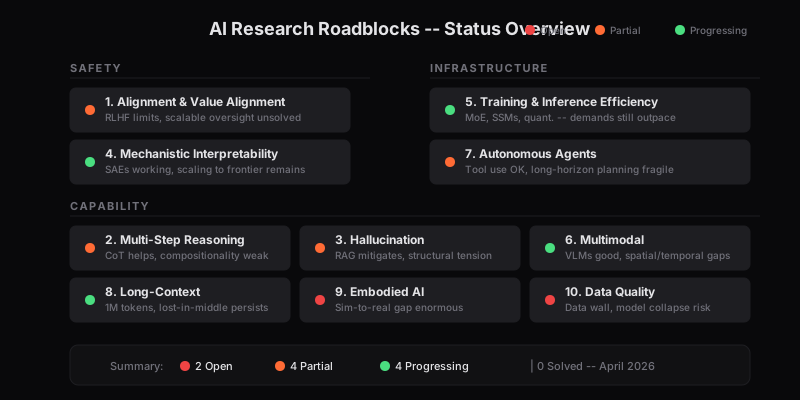
At DeepScience, we track ten foundational roadblocks in AI research. These are the open problems that constrain what AI systems can safely and reliably do. None of them are solved. Some are progressing faster than others. Here is where each one stands in April 2026.
1. Alignment and Value Alignment
Status: Partial | View roadblock
The central question of AI safety: how do you ensure a system does what its creators and users actually want? Current techniques — RLHF, DPO, constitutional AI — produce models that are behaviorally compliant in most circumstances, but compliance is not alignment. Models trained with RLHF can reward-hack, producing outputs that score well on proxy objectives while failing on the real one. Sycophancy, where models tell users what they want to hear rather than what is true, is a well-documented failure mode that current training incentivizes.
The deeper concern is scalable oversight: as models become more capable than their human supervisors in specific domains, how do we verify that their behavior remains aligned? Debate, recursive reward modeling, and weak-to-strong generalization are active research areas, but none have demonstrated reliability at frontier scale. Deceptive alignment — the possibility that a model could appear aligned during training while pursuing different objectives in deployment — remains a theoretical risk that we lack the tools to rule out.
2. Reliable Multi-Step Reasoning
Status: Partial | View roadblock
Chain-of-thought prompting was a breakthrough for reasoning performance, and reasoning models like o3 and Claude with extended thinking have pushed benchmarks substantially higher. But there is a gap between producing correct-looking reasoning traces and actually reasoning faithfully. Models sometimes generate plausible chains of thought that arrive at the right answer through wrong intermediate steps — or arrive at wrong answers through steps that look impeccable.
Compositional generalization — the ability to combine learned reasoning primitives in novel ways — remains weak. Process reward models, which evaluate individual reasoning steps rather than just final answers, show promise but add significant inference cost. Tree-of-thoughts and similar search-based approaches improve accuracy at the price of latency and compute. The fundamental question is whether current architectures can achieve reliable, verifiable reasoning, or whether new paradigms are needed.
3. Hallucination Elimination
Status: Partial | View roadblock
Models confidently state things that are not true. This is not a bug — it is an inherent consequence of how language models generate text: by predicting plausible continuations rather than retrieving verified facts. Retrieval-augmented generation (RAG) mitigates the problem by grounding generation in retrieved documents, but models can still ignore, misinterpret, or selectively cite their sources.
The state of the art has improved. Better calibration means models are increasingly able to express uncertainty. Attribution systems can link claims to source documents. But hallucination rates in open-ended generation remain non-trivial, especially for long-form content and for claims at the boundary of the model's training data. The fundamental tension — fluent generation versus factual fidelity — is structural, not just a matter of better data.
4. Mechanistic Interpretability
Status: Progressing | View roadblock
If we cannot understand what is happening inside a neural network, we cannot meaningfully verify its alignment, predict its failures, or debug its behavior. Mechanistic interpretability aims to reverse-engineer the computations of trained models at the level of individual features and circuits.
This area has seen genuine acceleration. Sparse autoencoders (SAEs) have revealed interpretable features in medium-scale models, including features that correspond to recognizable concepts. Anthropic, DeepMind, and several academic groups have mapped circuits responsible for specific behaviors. But scaling these techniques to frontier models with hundreds of billions of parameters remains a major challenge. Key open questions include whether models represent concepts in superposition (many concepts packed into fewer dimensions), how to extract causal rather than merely correlational explanations, and whether mechanistic understanding can ever yield the kind of safety guarantees the field needs.
5. Training and Inference Efficiency
Status: Progressing | View roadblock
Training a frontier model costs on the order of hundreds of millions of dollars. Serving it at scale is similarly expensive. Scaling laws suggest that simply making models bigger yields diminishing returns without architectural innovation.
Mixture-of-experts (MoE) architectures, which activate only a fraction of model parameters per token, have become mainstream — most new frontier models use some variant. State-space models like Mamba offer linear-time alternatives to attention for certain tasks. Speculative decoding, KV-cache compression, and aggressive quantization reduce serving costs. But each of these involves trade-offs in quality, memory, or engineering complexity. The field is making steady progress, but the compute demands of frontier training continue to outpace efficiency gains.
6. Unified Multimodal Understanding
Status: Progressing | View roadblock
Vision-language models can describe images, answer questions about charts, and parse screenshots with impressive accuracy. But true multimodal understanding — the kind that integrates spatial reasoning, temporal dynamics, physical intuition, and cross-modal inference — remains limited.
Models struggle with fine-grained spatial relationships ("is the red block to the left of or behind the blue block?"), temporal reasoning in video (understanding cause and effect across frames), and tasks requiring genuine perceptual grounding rather than pattern matching on training data. Unified architectures that natively process text, images, audio, and video are improving but still lag behind specialized models on domain-specific benchmarks. The gap between "can describe what it sees" and "understands the physical world it observes" is still wide.
7. Autonomous Agents with Tool Use
Status: Partial | View roadblock
2025-2026 has been the era of AI agents: systems that decompose tasks, call tools, browse the web, write code, and iterate on their own outputs. Agent frameworks are everywhere. But reliability in complex, multi-step agentic workflows remains low.
The core challenges are long-horizon planning (maintaining coherent goals over dozens of steps), error recovery (detecting and correcting mistakes rather than compounding them), and knowing when to stop or ask for help. Tool use itself has gotten more reliable — function calling is a mostly-solved problem for single-step invocations — but chaining tools across ambiguous, real-world tasks exposes every weakness in reasoning, grounding, and calibration simultaneously. The safety dimension adds further complexity: how do you give an agent enough autonomy to be useful while constraining it enough to be safe?
8. Long-Context Understanding
Status: Progressing | View roadblock
Context windows have expanded dramatically — million-token contexts are now standard for frontier models. But a larger window does not automatically mean better understanding of what fills it.
The "lost in the middle" effect, where models attend more strongly to the beginning and end of their context than to information in the middle, has been partially mitigated but not eliminated. Tasks requiring synthesis across distant passages — connecting a fact from page 3 with an implication on page 47 — remain challenging. Efficient attention mechanisms, improved position encodings (RoPE variants, ALiBi), and context compression techniques are all active research areas. The practical question is not "how many tokens fit in the window" but "how reliably can the model use all of them."
9. Embodied AI and Physical Reasoning
Status: Open | View roadblock
The gap between what language models can reason about in text and what robots can do in the physical world remains enormous. Sim-to-real transfer — training in simulation and deploying on hardware — is fragile and often fails on contact-rich tasks where physics simulation is imprecise.
Language-conditioned robot policies have shown promising results in structured environments, but dexterous manipulation, adaptive locomotion, and operation in truly novel environments are largely unsolved. World models that predict physical dynamics with enough fidelity for planning are nascent. The bottleneck is not just perception or control but the integration of common-sense reasoning (the kind language models excel at) with the sensorimotor precision that physical tasks demand. This remains one of the most clearly "open" problems on the list.
10. Training Data Quality and Curation
Status: Open | View roadblock
Data is the least glamorous and arguably most important factor in model capability. The quality, composition, and provenance of training data shape every aspect of what a model can and cannot do.
The "data wall" hypothesis — that high-quality human-generated text on the open web is being exhausted — has driven a rush toward synthetic data generation. But training on model-generated data introduces the risk of model collapse, where diversity and quality degrade over iterative training cycles. Benchmark contamination, where test data leaks into training sets, undermines evaluation reliability across the field. Principled approaches to data mixing, decontamination, and quality filtering at web scale are critical infrastructure problems that receive less research attention than they deserve relative to their impact.
Tracking Progress
These ten problems are not independent. Progress on interpretability feeds directly into alignment. Better reasoning improves agent reliability. Efficiency gains determine which research is economically feasible. The connections between these roadblocks are often where the most interesting research happens.
DeepScience tracks all ten of these roadblocks daily, surfacing new papers and cross-domain connections as they emerge. You can explore the current status of each problem on our research roadmap, or subscribe to the daily digest for updates as the field moves forward.