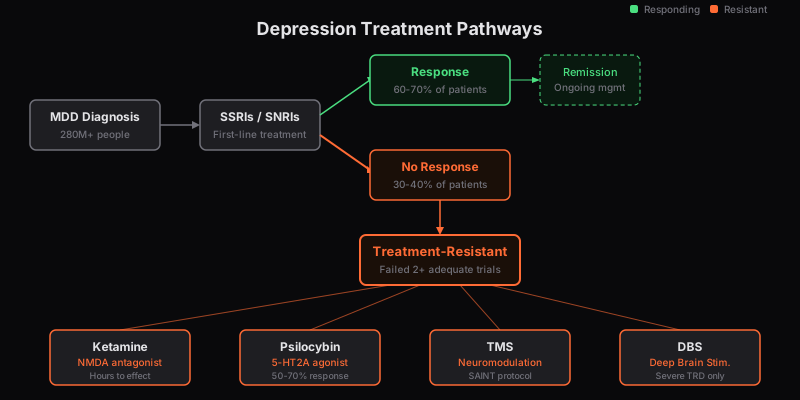
Depression is the leading cause of disability worldwide, affecting more than 280 million people. For most, first-line treatments — selective serotonin reuptake inhibitors (SSRIs) and cognitive behavioral therapy — work well enough. But for roughly 30% of patients with major depressive disorder, two or more adequate courses of antidepressant treatment fail to produce remission. These patients meet the clinical definition of treatment-resistant depression, or TRD.
That 30% figure translates to tens of millions of people living with a condition that the standard toolkit cannot reach. Understanding why their depression resists treatment, and what alternatives exist, is one of the most consequential problems in all of medicine. Here is where the science stands in 2026.
What Makes Depression Treatment-Resistant?
The honest answer is: we do not fully know. The term "treatment-resistant depression" describes an outcome — failure to respond — rather than a distinct biological entity. Two patients with identical TRD diagnoses might have fundamentally different underlying pathologies.
Several factors increase the likelihood of treatment resistance. Chronic stress exposure, childhood trauma, and co-occurring anxiety or substance use disorders all predict poorer antidepressant response. There is growing evidence for distinct biological subtypes of depression — some driven primarily by serotonergic dysfunction, others by neuroinflammation, HPA axis dysregulation, or glutamatergic imbalances. A patient whose depression stems from elevated neuroinflammation may be biologically incapable of responding to an SSRI that targets serotonin reuptake. This is not treatment resistance so much as treatment mismatch.
The lack of objective diagnostic tools compounds the problem. Psychiatry still relies on symptom-based classification — questionnaires like the PHQ-9 and HAM-D that measure subjective experiences. Two patients scoring identically on these instruments might have entirely different neurobiological profiles. Without reliable biomarkers to guide treatment selection, clinicians are left to trial-and-error their way through medication options, a process that can take months or years.
The Standard Toolkit and Its Limits
SSRIs and SNRIs
Selective serotonin reuptake inhibitors remain the first-line pharmacological treatment for depression. They work by blocking the reabsorption of serotonin in the brain, increasing its availability in synaptic clefts. SNRIs (serotonin-norepinephrine reuptake inhibitors) add norepinephrine modulation. Both classes take 4-8 weeks to show full effect.
The monoamine hypothesis — the idea that depression results from deficient serotonergic or noradrenergic neurotransmission — guided antidepressant development for decades. It is now widely recognized as incomplete. SSRIs increase synaptic serotonin within hours, yet therapeutic effects take weeks, suggesting that downstream processes like synaptic plasticity and neural circuit remodeling are doing the actual work. For TRD patients, these downstream mechanisms may be impaired for reasons that have nothing to do with serotonin levels.
Augmentation Strategies
When SSRIs fail, clinicians typically try augmentation: adding a second medication to boost the antidepressant's effect. Lithium, atypical antipsychotics (particularly aripiprazole and quetiapine), and thyroid hormone have the best evidence base. These strategies produce remission in an additional 10-30% of patients. For the remainder, clinicians move to more aggressive interventions.
Emerging Therapies
Ketamine and Esketamine
Ketamine, an NMDA receptor antagonist originally developed as an anesthetic, has arguably been the most important development in depression treatment in the past two decades. A single intravenous infusion of ketamine can produce antidepressant effects within hours — a dramatic contrast to the weeks required by SSRIs. For patients in acute suicidal crisis, this speed is lifesaving.
Esketamine (Spravato), the S-enantiomer of ketamine delivered as a nasal spray, received FDA approval for TRD in 2019. It must be administered under clinical supervision, and its effects typically last days to weeks rather than being permanent. The maintenance treatment burden is significant: patients may need twice-monthly sessions indefinitely.
The mechanism of ketamine's antidepressant action is still being worked out. It involves NMDA receptor blockade, increased AMPA receptor signaling, rapid BDNF release, and activation of the mTOR signaling pathway — collectively producing a burst of synaptogenesis and neuroplasticity. This "plasticity window" may be what allows rapid circuit-level changes that SSRIs achieve only slowly, if at all.
Psilocybin-Assisted Therapy
Psilocybin, the active compound in psychedelic mushrooms, has emerged as one of the most promising candidates for TRD treatment. Phase II trials have shown response rates of 50-70% in patients who had failed multiple prior treatments — numbers that exceed most existing interventions. Several Phase III trials are underway or recently completed as of 2026.
Unlike ketamine, psilocybin therapy is designed as a short course — typically one to three supervised sessions, each involving several hours of guided psychotherapy. The acute experience involves profound alterations in perception, emotion, and sense of self, mediated primarily through 5-HT2A serotonin receptor agonism.
The mechanistic picture is fascinatingly complex. Psilocybin appears to work through at least three overlapping channels: pharmacological (receptor-level changes promoting neuroplasticity), network-level (disrupting rigid patterns in the default mode network that characterize depressive rumination), and psychological (the subjective content of the experience itself, particularly feelings of connectedness and meaning). Disentangling the relative contributions of these mechanisms is an active area of research and has direct implications for how protocols are designed.
Transcranial Magnetic Stimulation
Repetitive transcranial magnetic stimulation (rTMS) uses focused magnetic pulses to stimulate specific brain regions, typically the left dorsolateral prefrontal cortex (DLPFC). FDA-cleared for TRD since 2008, standard rTMS protocols require daily sessions over 4-6 weeks, which limits accessibility.
The Stanford Accelerated Intelligent Neuromodulation Therapy (SAINT) protocol, introduced in 2022, compressed the treatment into five days of intensive stimulation guided by functional MRI targeting. Initial results showed remission rates near 80% in a small TRD sample — remarkable if replicated at scale. Larger trials are ongoing. The approach exemplifies a broader trend toward precision neuromodulation: using neuroimaging to identify the exact cortical target for each individual patient rather than relying on anatomical landmarks.
Deep Brain Stimulation
Deep brain stimulation (DBS) for depression involves surgically implanting electrodes in specific brain regions — typically the subcallosal cingulate (Brodmann area 25) or the ventral capsule/ventral striatum. It is reserved for the most severely treatment-resistant patients, those who have failed all other options.
Results have been mixed but instructive. The largest randomized trial (the BROADEN study) failed to meet its primary endpoint, but post-hoc analyses and long-term follow-up suggest that with proper patient selection and stimulation optimization, response rates of 40-60% are achievable. The field is moving toward closed-loop DBS systems that adjust stimulation in real time based on neural biomarker signals, rather than delivering constant stimulation. This represents a convergence of neurostimulation with computational psychiatry approaches.
The Biomarker Problem
The recurring theme across TRD research is heterogeneity. Patients who look identical by symptom questionnaires may have vastly different underlying biology. Without objective markers to stratify patients, every clinical trial mixes responders and non-responders, diluting effect sizes and making promising treatments look mediocre.
The search for reliable psychiatric biomarkers spans multiple modalities. Inflammatory markers like C-reactive protein (CRP) and interleukin-6 (IL-6) can identify a subgroup of depressed patients with elevated neuroinflammation who may respond preferentially to anti-inflammatory interventions. EEG-based biomarkers, particularly frontal theta cordance, show some ability to predict SSRI response within the first week of treatment. Neuroimaging studies have identified functional connectivity patterns in the default mode network and salience network that correlate with treatment outcomes.
None of these biomarkers has achieved the sensitivity and specificity needed for routine clinical use. The challenge is both technical — the measurements are noisy and context-dependent — and conceptual. Depression may not be a single disorder with a single biomarker signature but rather a family of conditions that share surface-level symptoms while differing at the circuit and molecular level.
Digital phenotyping offers a complementary approach. Patterns in smartphone use — typing speed, social interaction frequency, sleep regularity, mobility — can track mood state changes with surprising accuracy. Combined with wearable sensors measuring heart rate variability, skin conductance, and sleep architecture, digital biomarkers could enable continuous monitoring rather than point-in-time clinic assessments. The integration of these data streams with clinical decision-making is the domain of digital therapeutics, a field still working through validation and regulatory challenges.
Computational Psychiatry: A New Framework
Perhaps the most intellectually ambitious approach to TRD comes from computational psychiatry, which seeks to reframe psychiatric disorders as failures in neural computation. Under this framework, depression is not simply "low serotonin" but a state in which the brain's predictive models have become pathologically rigid — overweighting negative predictions and underweighting positive prediction errors.
Bayesian inference models of depression can explain why rumination is self-reinforcing: a brain that assigns high prior probability to negative outcomes will interpret ambiguous evidence as confirmatory, creating a feedback loop that standard pharmacology may not disrupt. Reinforcement learning models explain anhedonia — the inability to experience pleasure — as a deficit in reward prediction signaling, potentially localized to specific dopaminergic circuits.
These models are not yet clinically actionable. The gap between a computational account of depression and a treatment recommendation for an individual patient remains large. But the framework is generating testable predictions about which patients will respond to which interventions, and early machine learning classifiers trained on combinations of neuroimaging, genetic, and clinical data show accuracy improvements over symptom-based prediction alone.
The Role of Sleep and Circadian Rhythms
Sleep disruption is so consistently associated with depression that it can be difficult to determine where one condition ends and the other begins. Most depressed patients report insomnia or hypersomnia. Total sleep deprivation, paradoxically, produces rapid but transient antidepressant effects in about 60% of patients — an observation that has fascinated researchers for decades.
The sleep-circadian connection to depression runs through multiple pathways: circadian disruption alters cortisol cycling, impairs glymphatic clearance of metabolic waste from the brain during sleep, and dysregulates neurotransmitter synthesis. Chronotherapy — systematically manipulating sleep timing — and bright light therapy are evidence-based treatments for depression with a circadian component, yet they remain underutilized compared to pharmacotherapy.
For TRD specifically, addressing sleep and circadian dysfunction may be necessary groundwork before other interventions can take effect. A brain deprived of restorative sleep is a brain operating under conditions that actively oppose the neuroplasticity that treatments like ketamine and psilocybin are trying to promote.
Where We Stand
Treatment-resistant depression is not a monolith, and that is both the source of the problem and the path toward solving it. The field is moving — unevenly but genuinely — toward a precision psychiatry model in which treatment selection is guided by biology rather than trial and error.
The key advances of recent years have been mechanistic rather than pharmacological. We understand better why SSRIs fail for certain patients, how ketamine produces rapid effects through neuroplasticity pathways, and what psilocybin does to default mode network rigidity. We are beginning to identify patient subgroups who respond to neuroinflammatory interventions, computational models that predict treatment response, and digital tools that monitor disease state continuously.
What we lack is integration. The biomarkers, computational models, digital phenotyping tools, and novel therapeutics are being developed in parallel by largely separate research communities. The patients who need them most are waiting.
At DeepScience, our AI pipeline scans the latest research across psychiatry, neuroscience, computational science, and adjacent fields daily, looking for exactly these cross-domain connections. Our mental health roadmap tracks each of the open problems discussed in this article, and our daily digest surfaces the papers and breakthroughs that matter most. The science of TRD is moving fast. Keeping up with it should not require a full-time effort.